Science & Evidence

Nature came first.Science helps us understand it.

Black Beech Honey begins in the forest.

Its character is shaped by the relationship between Southern beech trees, native scale insects, honeybees, weather and time.

Scientific research lets us look more closely at what this ecosystem creates — its origin, its natural composition, and the differences found from one harvest to another.

Evidence is not something to place behind a claim.It is something to explore.
01 — Forest Ecology & Origin

Where It Begins

Black Beech Honey does not begin with flowers.

Native scale insects (Ultracoelostoma species) live on New Zealand beech trees and produce honeydew. Honeybees gather this honeydew and transform it in the hive.

It is a relationship between tree, insect and bee — shaped by the forest in which it occurs.

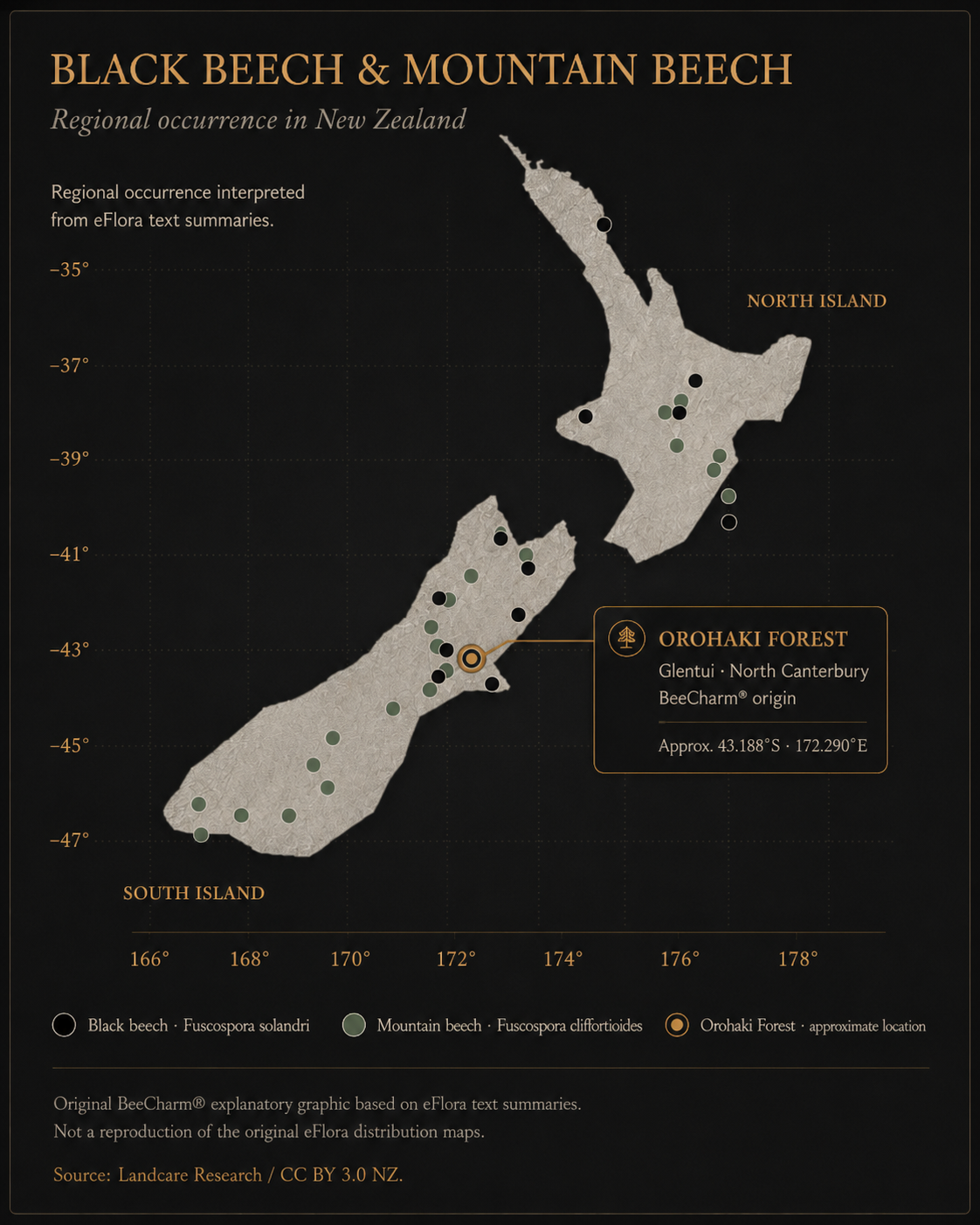
Bee Charm® originOrohaki Forest

Glentui · North Canterbury
South Island · New Zealand

Approx. 43.188°S · 172.290°E
Orohaki Forest shown within the known distribution of black and mountain beech forest in New Zealand
02 — Natural Composition

What the Forest Leaves Within

Beyond its deep colour and distinctive flavour, New Zealand honeydew honey contains a complex range of naturally occurring compounds.

Scientific research has examined its minerals, sugars and oligosaccharides, phenolic compounds, antioxidant activity and free amino acids. Each gives us another way of looking at what the forest, insects and bees create together.

01Published research context

Minerals

Research comparing New Zealand honey types has found honeydew honey to have a distinctive mineral profile.

Potassium was the dominant mineral reported, alongside phosphorus, magnesium, calcium and sodium. In one comparative study, honeydew honey recorded the highest mean total mineral content among the honey types examined.

Potassium · Phosphorus · Magnesium · Calcium · Sodium
A forest leaves more than a flavour. It leaves a chemical signature.
02Published research context

Sugars & Oligosaccharides

Honeydew honey has a different beginning from blossom honey — and its carbohydrate composition reflects that difference.

Research on New Zealand beech honeydew has identified fructose and glucose together with a range of naturally occurring sugars and oligosaccharides.

Palatinose · Turanose · Erlose · Melezitose
Different origin. Different composition.
03Published research context

Antioxidant Research

Scientific analysis of New Zealand honeydew honey has identified a range of phenolic compounds and measured antioxidant activity using established laboratory methods.

These measurements describe laboratory-observed chemical activity. They are not presented by Bee Charm® as medical or therapeutic claims.

Pinocembrin · Abscisic acid · Pinobanksin
Science is most valuable when comparison leads to understanding — not competition.
04Published research context

Amino Acids

Research has also begun to describe another layer of honeydew honey's natural composition.

A 2022 study quantified 17 free amino acids in New Zealand honeydew honey, with proline reported as the most abundant.

L-aspartic acid · L-glutamic acid · L-alanine · L-phenylalanine
There is still more to learn. And that is part of what makes the science meaningful.
03 — Research Highlights

A Closer Look

These figures describe findings reported in published research on New Zealand honeydew honey. They do not represent guaranteed values for every Bee Charm® harvest.

4,060mg/kg

Mean total mineral content reported for honeydew honey in one comparative New Zealand study.

17free amino acids

Quantified in a 2022 analysis of New Zealand honeydew honey.

FRAP · CUPRAC · PMlaboratory assays

Established methods used to examine antioxidant activity in published research.

04 — Our Batch Evidence

Published Research. Individual Harvests.

Published science helps us understand New Zealand honeydew honey as a category. But every Bee Charm® harvest is its own harvest.

That is why we distinguish between published scientific research and measurements taken from individual batches.

BBH® records the natural colour expression of each mature harvest. It is not a medical, therapeutic or potency rating.
Depending on the harvest, laboratory records may include
Pfund Colour
Brix
Moisture
Electrical Conductivity

Research helps us understand the honey.The batch record tells you about your harvest.

How we measure each harvest — Understanding BBH® →
05 — Evidence Library

Explore the Evidence

We believe scientific evidence should be accessible, not hidden behind marketing.

The Bee Charm® Evidence Library brings together published research, scientific references and independent laboratory records relevant to New Zealand honeydew honey and individual Bee Charm® harvests.

Explore the Evidence Library →
01Research summaries
02Key findings
03Authors & institutions
04Journal / publication
05Original source / DOI
06Bee Charm® batch records

Nature gives us something to wonder about.

Science gives us another way to listen.